


Zohran Mamdani’s Historic Swearing-In as Mayor of New York City


By the time Zohran Mamdani stepped into the vast, silent chamber of the Old City Hall subway station just after midnight on January 1, 2026, New York had already signaled its intention to turn a page. Outside, Times Square hummed with revelers celebrating the New Year. Below ground, amid the echoing Beaux-Arts arches and the lingering smell of dust and cold stone, history was being made.
It was here, in a decommissioned subway station that had not seen regular service since 1945, that Mamdani, a Democratic Socialist and political outsider beloved by progressives and reviled by critics on the right, took his first, semi-private oath as the 112th mayor of New York City. He did so with his hand on a centuries-old Qur’an, placing faith and symbolism at the very foundation of his tenure.
At age 34, Mamdani became not only the youngest mayor in generations but also the city’s first Muslim mayor, its first of South Asian descent, and the first African-born leader of the city’s executive office, a constellation of firsts that reshapes the political map of one of the world’s most diverse metropolises. The station itself, once the flagship of New York’s original subway line, served as an extraordinary frame for Mamdani’s first act as mayor. Lit by portable lamps and the soft glow of media lights, it was both solemn and surreal, as if the ghosts of the city’s past lingered in celebration.
In that hush, New York Attorney General Letitia James, a staunch ally, administered the oath. Nearby, Mamdani’s wife, Rama Duwaji, stood with a composed presence, wearing fashion that would later spark its own pop-culture conversation.
“This is truly the honor and the privilege of a lifetime,” Mamdani said, his voice resonant under the arches. “It’s easier than explaining it. I don’t mind,” he added with a laugh when asked about the symbolism of his choice of setting and text.
For decades, New York’s mayoral oaths had often involved the Bible, a traditional gesture reflecting the nation’s majority faith. But Mamdani’s decision, grounded in personal identity and inclusive intention, marked a deliberate reframing of civic ritual. It spoke to an America in which the halls of power are finally beginning to acknowledge the kaleidoscope of belief systems that make up its population.
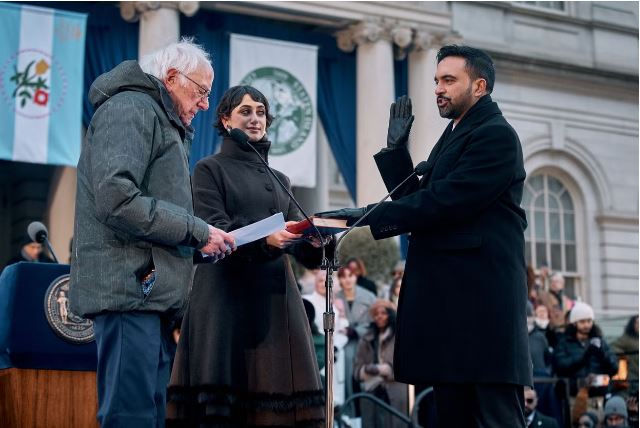
While the midnight ceremony was quiet and intimate, a second act unfolded later that day amid the sunlight and bustle at City Hall. On the grand steps overlooking Broadway’s “Canyon of Heroes,” an estimated thousand New Yorkers assembled for a public swearing-in administered by Senator Bernie Sanders, a political mentor of sorts and fellow democratic socialist.
Sanders looked out over the crowd, his graying hair and unmistakable voice a reminder of the political currents that buoyed Mamdani’s rise.
“In times where so many feel unheard, Zohran Mamdani’s leadership represents hope, not just in words, but in action,” Sanders declared. “May this city be a place where dignity is more than a slogan; may it be a reality for every New Yorker.”
Standing beside him, Representative Alexandria Ocasio-Cortez also spoke, connecting Mamdani’s platform to a broader movement for economic equity.
“We are here not for the politics of yesterday,” she said. “We are here for a future that works for the many, not just the privileged few.”
And then Mamdani took the stage, not in the cavernous quiet of a subway relic, but in the living, breathing heart of the city. The crowd swelled, banners waved, and the buzz of languages filled the air: Spanish, Mandarin, English, Punjabi, each a testament to the mosaic that is New York.
“My fellow New Yorkers,” he began, his voice carrying over the sea of faces, “today begins a new era. Beginning today, we will govern expansively and audaciously. We may not always succeed, but never will we be accused of lacking the courage to try.”
No New York inauguration would feel complete without music, color, and vibe, and Mamdani’s was no exception. The ceremony outside City Hall blended South Asian rhythms with American anthems, including a performance by Punjabi artist Babbulicious, whose viral track “Gaddi Red Challenger” supplied an unexpected yet spirited backdrop. The juxtaposition of cultures, beats that echoed through the streets, verses that seemed to dance with the energy of new beginnings, mirrored a city that has always thrived on fusion.
Throughout the day, residents across New York weighed in on what Mamdani’s ascendancy meant to them.
On the steps of City Hall, Maria Lopez, a Bronx nurse, wiped tears from her eyes as she spoke about her hopes.
“He’s one of us,” Lopez said. “He’s lived with rent struggles, transit delays, and family worries. This city finally feels like it sees me.”
Nearby, a group of high-school seniors from Queens reflected on Mamdani’s youth.
“It’s crazy to see someone our age up there,” said Jamal Khan, 17. “Maybe now we really believe we can do something too.”
Behind the pomp and color lay the heft of expectations. Mamdani’s campaign had been bold, from advocating for a rent freeze for nearly one million households to proposing free public transit and grocery initiatives to crack down on food insecurity.


Comments